A Revolution in Time and Thought
Chapter 1: Revolution In Time
(1) The Time We Truly Own in Life

Let’s imagine a person lives from birth to the age of 80. Now, out of those 80 years, how many seconds do you think you actually have in your lifetime?
Here’s the surprising answer: it’s approximately 2.5 billion seconds.
Some people might hear that number and think it’s a lot, while others may feel it’s surprisingly little. Either way, chances are it’s very different from what most people would have guessed.
But here’s where it gets more interesting: out of those 2.5 billion seconds, we spend about one-third of our lives asleep. Assuming an average of 8 hours of sleep per day, that leaves us with only about 1.7 billion waking seconds.
Now subtract the time spent working or doing other obligations—let’s say roughly another third—and we’re left with around 800 to 900 million seconds of truly free time in a lifetime.
That’s it. Not 2.5 billion seconds, but only about 900 million seconds that we can actually choose how to spend.
Very few people are aware of this. Unlike money, which we can see and count, time is invisible, and as a result, people tend to be far more aware of their finances than their time. This reveals a crucial truth: humans are highly sensitive to money but surprisingly insensitive to time.
When you look at life this way, it makes you realize how miraculous each encounter is.
To put this in perspective, while one lifetime gives you about 2.5 billion seconds, the global population is around 7.7 billion people. Even if you met and shook hands with one person every single second of your life, you’d still never meet two-thirds of the people on Earth before your time runs out.
No matter how efficiently you use your time, you’ll likely never even speak to 5 billion of them. That’s why the people you meet in your life—especially in this very moment—are part of something incredibly rare. A miracle, even.
Interestingly, in English, the word “present” means both “now” and “a gift.” This isn’t a coincidence. The present moment is, quite literally, a gift—something we’ve been given, something fleeting, and something profoundly valuable.
So let’s appreciate this moment for what it is, and choose to live fully in the now.
Here’s another thought: have you noticed how time seems to speed up as you get older? A single year as a child felt like an eternity, but now, as an adult, years seem to vanish in a blink.
There’s a simple psychological explanation. For a 7-year-old, one year is one-seventh of their entire life—a huge proportion. For a 70-year-old, one year is just one-seventieth. The older you get, the smaller each year feels in relation to your whole life.
This shift in perspective is what shapes our perception of time, and it’s a reminder: the time you have today is more precious than you think.
(2) Our Values on Money and Time

Let me start with a sudden question.
Imagine this: Every day at midnight, your bank account is automatically credited with ¢86,400. However, the catch is—whatever amount you don’t use by the end of the day disappears. Then, at the stroke of midnight, another ¢86,400 is deposited again, and the same cycle continues. In other words, you receive ¢86,400 every single day, but any unused amount vanishes when the day ends.
What would you do in that situation?
Most people would try to withdraw and use every last dollar, right? You wouldn’t want to waste even a single cent. You’d make sure to make full use of that daily deposit.
Now, can you see where this is going?
That’s exactly how time works.
Every day, life grants us 86,400 seconds—the same way this imaginary bank gives you money. And just like the unused dollars, these seconds expire at the end of the day. You can’t carry them over, you can’t save them for later.
While we would never let money go to waste so carelessly, we rarely treat our time with the same level of urgency or value.
You can save money. You can invest it and even grow it. But time? You can’t save it. You can’t invest it for a return. Once it’s gone, it’s gone forever.
And yet, most of us live each day with a constant awareness of money, while giving barely any conscious thought to time. We are driven by financial considerations, but we often let time slip away unnoticed.
Strange, isn’t it?
You can trade your time for money—through a salary or hourly wage—but no amount of money can ever buy back even a single second of lost time.
Still, we focus far more on money than on time. We let money dictate our choices, even though it’s our time that’s truly priceless.
(3) The Fish Tank and the Time of Your Life

Let me share with you a story from a university lecture—one that carries a powerful lesson about time management.
One day, a professor stood before his class and said, “I’m going to ask you some questions. I want you to think carefully about your answers.” He then pulled out a large, empty fish tank from under his desk and placed it on the table.
Next, he began to fill the tank with large rocks, one by one, until it appeared completely full.
He turned to the students and asked, “Is this tank full?” The students replied, “Yes, it’s full.”
But then, the professor pulled out a container of small pebbles and began to pour them into the tank. The pebbles slipped into the spaces between the large rocks. When he was finished, he asked again, “Now, is the tank full?” The students laughed and said, “No, not yet.”
Then, the professor took some sand and poured it in, letting it fill even the tiniest gaps. And finally, he poured water into the tank until it reached the brim.
He looked up and said, “Do you see what I’m getting at? This tank represents the time you have in a single day. Everyone receives the same tank—24 hours. But how you fill it determines everything.”
He continued, “The large rocks are the most important things in your life—your family, your career, your health. These must go in first. If you start with the small stuff—the pebbles, the sand, the water—there won’t be room for the big rocks. But if you start with the big rocks, there’s still space for the smaller priorities: appointments, errands, hobbies, and finally the casual moments that fill in the rest.”
“That,” he said, “is how you make the most of each day. Everyone has the same size tank, but only those who learn how to arrange the contents wisely will succeed. Master the art of choosing and placing your ‘rocks,’ and you master your time.”
The students nodded, clearly impacted. Their awareness of how they spent their time shifted in that moment.
In this way, thinking of time as a fish tank helps us visualize how to manage our day more effectively. Like playing a game of Tetris, it’s not just about fitting everything in—it’s about fitting it in smartly. The better your strategy, the higher your productivity.
(4) A Daily Schedule to Maximize Your Productivity

To make the most of your workday and operate at peak efficiency, you need to master four key areas:
- The difference between other people’s time and your own time
- How to restore and manage your focus
- The concept of the 3Ms and effective time management
- Improving and optimizing your sleep quality
Let’s break down each of these elements.

There Are Only Two Types of Time: Other People’s Time and Your Own Time
Other People’s Time
This includes tasks you’re obligated to do: commuting, unnecessary meetings or phone calls, emails you don’t want to deal with, and social events you attend out of obligation rather than desire.
Your Own Time
This is time you spend doing things you enjoy or find meaningful: fulfilling work, hobbies, personal goals, fun events, and quality time with people you genuinely enjoy.
Most people spend far more time in other people’s time without realizing it. Our days are often consumed by obligations, social expectations, and tasks driven by others’ needs. Because it’s so normalized, we don’t always notice how little of our day is actually ours.
As a result, we end up frustrated, wondering why another day passed without achieving anything meaningful. It can feel like you’re just drifting through time without direction or fulfillment.
If You Want to Truly Improve the Quality of Your Life:
Increase your own time + Decrease other people’s time = A Higher Quality of Life
This formula is essential to understand. The real danger lies in not recognizing just how much of your time is being claimed by others unnecessarily. To take back control, begin asking yourself a simple but powerful question before acting or thinking:
“Who is this really for?”
If you don’t, your time will continue to be quietly eroded.
By consciously investing more of your own time into self-development, growth, and activities that align with your values, you not only become more productive—you also improve the overall quality of your life.

There are many times when a task that usually takes just one hour ends up taking over two, simply because of fluctuating levels of focus.
Poor productivity is essentially the same as a decline in the quality of time spent. In other words, too much of our time is wasted—and most of that wasted time stems from a lack of concentration.
If we can learn to manage our focus, we can significantly boost our productivity and avoid spending more time on tasks than necessary. That’s why the ability to master our attention is so important.
The truth is, human focus isn’t an unlimited resource. It’s finite. That’s why understanding how focus works throughout the day—and planning accordingly—is crucial.
We’ll dive deeper into this topic in the section dedicated to focus and attention.

There Are Actually Three Types of Time Management
- Task Management
- Schedule Management
- Time Resource Management
These three areas of management are collectively referred to as the 3Ms. The sum of these three is what we call Time Management. Once you become aware of the 3Ms, you’ll find it much easier to take control of your day. You’ll be able to eliminate wasted pockets of time and use them more effectively.
Task Management
Task Management, as the name suggests, refers to how you organize and handle your work-related responsibilities. This includes high-priority tasks and things you absolutely must complete today. If you don’t organize your top-priority tasks, you’ll end up postponing what really matters.
There are two key points to effective Task Management:
- Organizing task content
- Visualizing start dates and deadlines
Before doing anything else, it’s essential to gather and sort the information needed to complete a task. Without this clarity, you’ll often realize halfway through that you’re missing important details. That leads to backtracking and wasted effort.
It’s also crucial to set clear start and end dates. Without defining these, tasks become vague, and you may end up spending too much time on something that could have been done efficiently.
Schedule Management
Schedule Management refers to the organization of non-work commitments that are still important in daily life—like appointments, events, or meetings with others.
What most people typically think of as “calendar planning” falls into this category. This includes any activity that involves coordination with others and requires time to be allocated intentionally.
There are two core principles in Schedule Management:
- Estimating buffer time and flexibility
- Setting clear priorities
When managing your schedule, it’s best to estimate time allocations with a little cushion. This way, even if things run over slightly, you stay within range. It’s also important to allow some flexibility to handle the unexpected—this helps maintain your mental balance.
Highly effective people are usually excellent at prioritizing. They mentally rank tasks and appointments so they know exactly what needs to be handled first. Start with what’s most important and time-sensitive.
Time Resource Management
Any time not allocated to tasks or scheduled events falls under Time Resource Management.
“Resources” here refer to your personal time capital—the open blocks of time in your day. These are the moments that aren’t filled with tasks or structured appointments. How you use these windows of time is what separates successful individuals from the rest.
Examples might include:
- The 15 minutes between meetings
- A free hour in the evening
- Time during your commute
These moments, though small, can add up. If used wisely—for learning, rest, reflection, or preparation—they become powerful levers for productivity and personal growth.
By mastering the 3Ms—
・Task Management,
・Schedule Management, and
・Time Resource Management
—you gain full control over your day.
When all three are aligned, time becomes your ally, not your enemy.

Some people try to increase their daily productivity by drastically cutting back on sleep. You’ll even hear successful individuals say things like, “If you have time to sleep, keep working instead.”
There’s also a common belief that “those who keep grinding while others are asleep are the ones who succeed.” But this mindset is not something I would recommend.
Why? Because the downsides are simply too significant. In fact, many truly successful people actually advise the opposite: “Rest well. Sleep first—then get to work.”
Countless studies and medical research have proven that working while your brain and body are running on empty leads to significantly lower productivity. No matter how many hours you put in, the efficiency just isn’t there.
So instead of stealing time from your sleep to extend your workday, the real challenge is how effectively you can manage your time outside of your sleep hours.
Even if you feel like you don’t have enough time to get more than 7 hours of sleep a day, there are practical strategies you can try to make that possible—so give them a shot.
(5) Managing Your Schedule to Maximize Focus

Making the Most of Your Morning “Golden Time”
The brain operates at its peak level of focus for about 2–3 hours after waking up. If you’re not aware of this “golden time,” you risk wasting the most productive part of your day on low-priority tasks that don’t require much mental effort.
To avoid that, it’s essential to dedicate your morning hours to tasks that require deep thinking. This is how you can fully leverage your mental capacity and make the most of your time.
Neuroscience supports this: aligning high-focus tasks with your brain’s optimal performance window can double—or even more than double—your work efficiency.
It’s also widely said that one hour in the morning is worth four hours at night. In fact, studies using focus-measuring smart glasses show that the brain performs at its highest level between 6:00 and 7:59 AM. These findings make it clear just how valuable early-morning hours really are.
When it comes to your workload, it’s helpful to divide tasks into two categories: high-focus work and low-focus work.
- High-focus work
Tasks that require mental concentration—writing, creating presentation materials, reading in a second language, preparing for important meetings, or reading complex books. - Low-focus work
Routine tasks—checking emails, making phone calls, attending meetings, and administrative duties.
Your brain is in a reset and refreshed state after a good night’s sleep. Starting your day with high-focus work allows you to process tasks more efficiently.
Conversely, spending this peak-performance window on low-focus tasks is essentially wasting prime time.
To put this in perspective: if an hour in the morning is worth four hours at night, then spending just 30 minutes checking emails in the morning is equivalent to losing two hours of productive time.
Instead, consider these less mentally demanding tasks as “filler time”—like filling the empty spaces in a fish tank. Slot email or social media checks into these in-between moments rather than during your most valuable hours.
Now, while the first two hours of the morning are critical, there’s one 30-minute window that’s especially important: the half-hour after you’ve had a good night’s sleep and finished breakfast. This is when your ability to regulate your thoughts and behavior is strongest. If you’re looking to start something new, this is the time to act on it.
Naturally, this means you need to wake up early. For example, if you need to leave the house by 8:00 AM, try waking up at 6:00. Eat breakfast, then use the time between 6:30 and 7:30 exclusively for yourself. Design your schedule so you can devote this time to focused personal development.
Using this golden time for studying, training, or other self-improvement activities is one of the best investments you can make in yourself.
Three Effective Ways to Regain Focus
If you want to improve your focus, there’s one important brain chemical you should know about: serotonin.
Serotonin, often called the “happiness hormone,” is one of the brain’s three major neurotransmitters, along with norepinephrine (which heightens alertness) and dopamine (which amplifies pleasure). These chemicals play a critical role in regulating emotions, mental health, and even sleep.
When the brain detects stress or tension, it releases serotonin to help regulate the effects of norepinephrine and dopamine, aiming to restore balance to the autonomic nervous system. When serotonin levels drop, motivation and focus can suffer, making it harder to stay engaged or productive.
To restore your concentration, it’s essential to replenish serotonin levels and adopt habits that help elevate your mood and mental clarity. Here are three simple actions you can take immediately to start boosting your focus.
A. Rhythmic Exercise
Rhythmic physical activity offers numerous benefits, one of which is increasing serotonin levels. This doesn’t just help reduce anxiety and depressive feelings — it can also lift your mood and restore your energy and focus.
Activities like walking, light jogging, cycling, or even practicing tai chi activate the serotonin system in the brain. Remarkably, serotonin levels begin to rise around five minutes after starting such movement, peaking at around 20 to 30 minutes. However, pushing beyond that point to the extent of physical exhaustion may actually reduce serotonin’s effectiveness.
It’s important to avoid strenuous or uncomfortable forms of exercise that you dislike, as they’re less likely to be effective. A great place to start is with light exercise for about 20 minutes — enough to activate the system without overstressing the body.
B. Chewing
The prefrontal cortex, the part of the brain responsible for attention and focus, experiences a decline in blood flow due to aging and stress — factors that have also been linked to cognitive decline and depression.
Recent studies show that chewing can stimulate the hippocampus (a region deep in the brain), which in turn sends signals to the prefrontal cortex, increasing its blood flow. In experiments using near-infrared spectroscopy to observe brain activity, chewing gum for around 20 minutes significantly activated the prefrontal cortex by boosting blood circulation.
Chewing also appears to reduce stress. By focusing on the act of chewing, the autonomic nervous system stabilizes, helping to manage tension and improve performance, even under pressure.
C. Sunlight
Exposure to sunlight also stimulates serotonin production. In addition, sunlight’s ultraviolet rays help the body synthesize vitamin D — often referred to as the “sunshine vitamin.” While it is possible to get vitamin D from food, about 90% is typically obtained through sunlight exposure, with only 10% coming from diet.
It’s important to note that sunlight through windows does not help the body produce vitamin D, nor does exposure through skin covered in sunscreen. For the full benefit, you need to go outside and spend time in natural sunlight.
To restore your ability to concentrate, try incorporating these three key practices into your daily schedule. Adjusting your routine to include them can make a significant difference in your mental clarity and overall performance.
The 7 Drivers That Supercharge Your Focus
- Environment
- Posture
- Nutrition
- Emotions
- Habits
- Exercise
- Meditation
Environment
Surprisingly, the colors around you can significantly impact your ability to concentrate. This isn’t just speculation—it’s backed by color psychology.
If you use a pen holder, choose one in light blue. Light blue is known to enhance focus and make time feel like it passes more quickly. In contrast, red stimulates aggression and restlessness, making it harder to stay calm and focused. Yellow increases alertness, while green promotes relaxation. While red may hinder concentration, it can actually enhance performance in physical activity or romantic situations.
Of course, a cluttered room filled with objects drains your mental energy and willpower. There’s a neuroscientific explanation for this: the amygdala—part of the brain responsible for fear and emotional responses—reacts to clutter. When you pass by scattered items, your brain instinctively asks, “What’s this?” That subconscious questioning creates micro-distractions, which over time reduce your ability to concentrate and weaken your self-control.
Keeping your environment organized is more than just a matter of tidiness—it’s a mental performance enhancer. Make it a habit to clean and declutter your space regularly.
It can also help to change your location depending on the task at hand. For brainstorming and creative work, being in a space with a high ceiling can stimulate idea generation and boost creativity. On the other hand, for tasks that require precision and deep focus—like bookkeeping or administrative work—a space with a lower ceiling is better. These environments limit distractions and help you stay locked in.
In short: high ceilings support creativity, low ceilings support concentration. Choose your environment accordingly.
Posture
You’ve probably experienced this yourself—you’re lying down reading a book or scrolling through your phone, and before you know it, you’ve drifted off to sleep. This phenomenon is closely tied to how the brain functions.
In fact, the brain’s prefrontal cortex, which governs willpower, relies on two key energy sources: oxygen and glucose. The delivery system for both of these is blood flow.
A healthy brain receives about 15% of the body’s total blood supply at all times. That’s a surprising amount considering the brain only accounts for about 2% of total body weight. It’s remarkable how such a small organ demands so much of the body’s resources.
One of the most critical factors affecting blood flow to the brain is posture. Maintaining good posture helps activate the prefrontal cortex, allowing it to receive adequate oxygen. As a result, both memory and concentration can be restored simultaneously and more effectively.
However, maintaining good posture for extended periods can be challenging, and staying in a state of deep focus for long stretches is equally difficult. That’s why it’s highly recommended to stand up at least once every 15 minutes.
Numerous studies have shown that sitting for more than 15 minutes at a time can lead to a decline in cognitive function and concentration, which in turn reduces productivity. Even more concerning, people who sit for more than six hours a day face a 40% higher risk of death—even if they regularly exercise.
To counter this, try making a conscious effort to stand up regularly. You could take a quick walk to wash your hands or grab a drink—anything that gets you out of your chair.
In fact, research shows that standing while working can boost cognitive performance and decision-making skills, which is why many companies have started implementing “standing meetings” to improve productivity. Paying attention to your blood circulation by correcting your posture or simply standing up and taking a moment to relax can have a surprisingly powerful impact on your focus and well-being.
Nutrition
Did you know that your ability to focus can be significantly influenced by what you eat? Certain nutrients are particularly effective at enhancing willpower, and simply by consuming them, your body can store energy more efficiently.
There are six key nutrients involved:
- Glucose
- Fatty acids
- Phospholipids
- Amino acids
- Vitamins
- Minerals
Among these, glucose is the most crucial—it serves as the primary fuel for willpower. So, what should you eat to maintain focus? The answer is low-GI foods. These are foods that cause your blood sugar levels to rise and fall gradually, helping to sustain concentration over time.
GI stands for glycemic index, a measure of how quickly blood sugar levels increase after eating a particular food, typically tracked over a two-hour period. High-GI foods cause a rapid spike in blood sugar, while low-GI foods lead to a slower, more stable increase.
Why are low-GI foods preferable? Because rapid fluctuations in blood sugar levels can cause significant stress on the body, leading to irritability and a scattered attention span. Including low-GI foods in your meals helps maintain steady blood sugar levels, which in turn supports sustained focus.
Recommended low-GI foods include buckwheat noodles, brown rice, apples, cheese, and yogurt—all of which help maintain mental clarity for longer periods.
One useful strategy for incorporating low-GI foods is through smart snacking. There’s a good reason why mid-afternoon snacks—traditionally around 3 p.m.—have long been a cultural norm. Blood sugar levels typically start to dip about three hours after a meal, so having a snack at that point is actually quite rational. Eating foods like peanuts, cashews, almonds, or walnuts at this time can help boost cognitive performance.
There’s also a simple and highly effective method to improve focus that you can start using immediately: drink a glass of water every one to two hours.
Surprisingly, losing just 2% of your body’s water content can sharply reduce your ability to concentrate and lead to hormonal imbalances. Staying well-hydrated doesn’t just prevent dehydration—it also supports mental performance and enhances cognitive function.
Emotions
Have you ever heard of the term “flow experience”? It refers to those moments when you’re so deeply absorbed in an activity that you lose track of time—like when you’re working on something and suddenly realize the sun has set without even noticing. This intense state of concentration is often called being “in the zone,” and it’s what psychologists refer to as a “flow state.”
The concept was introduced by psychologist Mihaly Csikszentmihalyi. He described it as a mental state in which your full psychological energy is completely focused on the task at hand. Entering a flow state can lead to breakthroughs and levels of performance far beyond what you previously thought possible, fueled by deep concentration and total engagement.
This idea is especially well-known in the world of sports. Athletes who enter this state are able to filter out all irrelevant information, sharpening their judgment to distinguish between what is useful and what is not. This allows them to fully immerse themselves in the moment. So, how can we intentionally reach this state of flow?
A. Setting Clear Goals and Monitoring Feedback
First, it’s essential to define a clear goal for the activity. This doesn’t mean asking “why am I doing this?” but rather, “what outcome would mark this as complete or successful?”
Also, create an environment where you can monitor and receive feedback in real time. Sports, chess, and similar competitive activities often trigger flow precisely because they offer clear goals and immediate feedback.
B. Immersing Yourself in the Activity — Balancing Skill and Challenge
The most crucial factor in reaching a flow state is deep immersion in the activity. While this can be difficult, one key principle makes it easier: balancing your skills with the level of challenge.
If the task is too easy relative to your abilities, you’ll likely feel bored.
If the task is too difficult, it may lead to anxiety or even a sense of hopelessness.
The “flow channel” exists in the delicate space between boredom and anxiety. To fully immerse yourself, you must identify and stay within this zone.
C. Focusing Attention on the Present Moment
Direct your attention entirely to what’s happening right now. The goal is to shut out both negative and positive distractions and enter a state of pure absorption.
This means letting go of self-conscious thoughts and emotional reactions—getting lost in the moment, with a quiet mind and undivided focus.
D. Enjoying the Experience for Its Own Sake
A flow experience is intrinsically rewarding. The joy doesn’t come from the result or external rewards—it comes from the act itself.
This is driven by intrinsic motivation rather than external incentives. Ask yourself: What do I truly enjoy? What sparks deep curiosity in me? What gives my life meaning?
For some, joy arises when they are explaining something to others or organizing complex ideas into clear structures. Understanding what brings you this sense of fulfillment—what draws your attention and emotional engagement—can help you find your way into the flow state more easily.
Habits When people are deeply focused, they engage a part of the brain called the prefrontal cortex. Located about 2 to 3 centimeters behind the forehead, this region is significantly more developed in humans compared to other animals and is considered the brain’s central hub for thought and creativity.
One of the prefrontal cortex’s primary roles is to regulate thought and emotion. Thanks to this function, we’re able to control our mental state and direct our attention toward a single task or target for extended periods.
Interestingly, the prefrontal cortex is the core driver of human focus, but it has limited capacity. In neuroscience, the kind of focus that emerges from this brain activity is referred to as willpower.
When we make decisions or judgments, we also rely on the prefrontal cortex. However, something fascinating happens when we turn actions into habits: those tasks are gradually handed off to the cerebellum, a part of the brain responsible for automatic processing.
In other words, once something becomes a well-established habit, we no longer need to draw upon willpower to do it. This shift allows us to save mental energy and reduce fatigue—but only if we intentionally build systems of habit.
For example, think about learning to ride a bike. At first, all your attention and energy are focused on simply pedaling and staying upright.
But once you’ve mastered it, riding becomes second nature. Your brain no longer has to work hard to control every movement, and your attention can shift to enjoying the scenery or planning your day.
This is how new tasks drain willpower, especially when we’re unfamiliar with them. But once those tasks become routine, the prefrontal cortex gets a break, and the saved energy can be redirected toward learning or developing other habits.
So, the key is to hone one skill until it becomes automatic, freeing up mental resources to focus on the next goal. That’s how we conserve focus and build momentum.
People who succeed tend to:
- Focus on mastering one action at a time
- Use leftover willpower to form new habits
- Apply remaining willpower to develop new perspectives
And they repeat this process.
On the other hand, people who struggle often try to:
- Start going to the gym
- Pick up a new sport
- Begin waking up early
- Launch a full-scale social media strategy
They attempt to take on multiple unfamiliar challenges all at once. This overextension drains their willpower too quickly, leaving them overwhelmed and unable to follow through.
One of the most misunderstood concepts contributing to this problem is multitasking. The mental strain it places on the brain is far greater than most people realize.
Multitasking can lower your focus by 40%, drop your IQ by 10 points, and increase error rates by 1.5 times. Not only that, but it also slows down task performance by 40%, disrupts your autonomic nervous system, and leads to increased irritability.
In short, multitasking not only exhausts your brain but also increases the chance of mistakes and slows you down dramatically. It’s best to avoid it altogether.
Instead, pick one task and stick with it for at least three weeks. Once it becomes automatic—handled by your cerebellum—you’ll free up willpower and can begin working on something new. This is the most efficient and sustainable way to build lasting habits without burning out.
Exercise
We’ve all heard it countless times:
Exercise is important. You should move your body. It’s good for your health.
But how many people can actually explain why exercise is beneficial—backed by science? Surprisingly, not many.
Let’s take a clear look at the wide range of benefits that exercise offers:
- Deeper, better-quality sleep
- Reduced risk of cognitive decline and dementia
- Improved memory and concentration
- Increased muscle mass
- Boosted immune function
- Faster recovery from fatigue
- Stress relief
- Reduced risk of physical illnesses
- Higher motivation levels
- Greater emotional stability
- Effective for weight management
- Preventive and therapeutic effects on mental health disorders
Exercise promotes blood circulation and stimulates the release of dopamine, the neurotransmitter responsible for motivation and drive. Research shows that just around 20 minutes of physical activity a day can enhance cognitive function, reasoning, and mental clarity for up to 3 to 4 hours afterward.
Some studies even report that memory can improve by 20%, and academic performance can increase by 10% through regular physical activity. One of the key mechanisms is increased blood flow to the hippocampus—the part of the brain that governs memory. This region can actually grow by about 2% per year through consistent exercise.
By contrast, the hippocampus typically shrinks by about 1% annually without intervention. So, simply through regular movement, you can reverse that decline—demonstrating just how powerful exercise truly is. Among all available methods, aerobic exercise remains one of the most effective approaches. Aim for about 20 minutes of moderate activity that gets your heart rate up without pushing too hard.
Meditation
The benefits of meditation are also far more extensive than most people realize.
Short-term benefits include:
- Sharper focus
- Increased sense of well-being
- Reduced perception of pain
- Greater physical resilience
- Alleviation of depression and anxiety
- Reduced stress
- Deep relaxation
Long-term benefits include:
- Longer lifespan (thanks to preserved telomeres)
- Positive structural changes in the brain
- Weight management support
- Stronger immune system
- Quicker, more agile thinking
Many highly successful individuals consistently name meditation as a key to maintaining mental focus—and it’s widely practiced by people across industries. Major companies like Apple, Google, Facebook, and others have adopted meditation programs in the workplace, often integrating them into daily routines.
One reason for this is that meditation helps suppress cortisol, the hormone released in response to stress. Studies suggest that regular meditation can be even more effective at reducing stress than many prescription anti-anxiety medications.
Its advantages are far-reaching: meditation enhances mental clarity, emotional regulation, and overall health.
And it doesn’t stop there—meditation can literally change the structure of your brain.
It increases the volume of certain brain regions while decreasing others, yielding a host of benefits. For example, the hippocampus—the memory center we mentioned earlier—can also grow through meditation.
It also enhances the temporoparietal junction (TPJ), the part of the brain associated with empathy and understanding others’ thoughts and feelings. As a result, you not only boost memory but also become more emotionally intelligent and compassionate.
At the same time, meditation can shrink the amygdala, the region responsible for processing fear and anxiety. This leads to reduced stress reactivity, greater emotional calm, and a naturally more positive mindset.
Incorporating meditation into your daily life can sharpen not just your focus, but also many other essential mental and emotional capacities. In other words—there’s no reason not to try it.
So far, we’ve explored highly specific, research-backed strategies for restoring and enhancing concentration. Mastering just these techniques alone can dramatically expand the productive hours in your day.
When you understand how to refuel your energy properly, you’ll be able to recover from mental dips efficiently and return to high performance with minimal time lost. Take these insights and make them part of your daily routine—they have the power to transform your focus, mindset, and quality of life.
(6) Two Powerful Time Management Techniques

The key to productivity lies in how well you can manage and recover your focus.
People who are considered highly focused aren’t necessarily those who can work for long hours nonstop. Rather, they are those who can consistently deliver high performance in short bursts of time. With that in mind, here are two focus management techniques frequently used by top athletes and business leaders alike.
The Pomodoro Technique
The Pomodoro Technique is a time management method that involves working in intervals of 25 minutes followed by a 5-minute break. It’s simple: break down your tasks into manageable chunks and tackle them one by one, inserting short breaks in between.
The goal is to intentionally stop working while you’re still engaged—just before you feel “done.” This creates a sense of “I want to keep going” or “I’m not quite finished,” which fuels motivation. This is sometimes called the “deadline effect” or “time pressure effect,” and it’s a widely endorsed strategy in psychology.
In an empirical study on concentration and learning retention conducted by Professor from the University of Tokyo, a group that studied for three 15-minute sessions with breaks in between (a total of 45 minutes) scored higher on tests than a group that studied for a continuous 60 minutes.
A common misconception is that motivation comes before action. In reality, motivation often comes after you’ve started. This is known as the “activation phenomenon.” By training yourself to dive into work immediately after a short break—without overthinking—you trigger dopamine release, which reduces anxiety and indecision, and sharpens your focus.
Don’t wait to feel motivated. Instead, take action to become motivated. Build your schedule around this principle and make a clear task list ahead of time.
One important rule: avoid switching tasks right before or right after a break. When your mind is on “autopilot” during breaks, it continues to process what you were just working on in the background. That’s why many people find that great ideas come to them after just a few minutes away—it’s your brain working efficiently under the surface.
The Ultradian Rhythm Technique
While the first technique involves alternating short periods of focus and rest, this next method is ideal for maintaining concentration over longer periods. It also helps you feel as though time is expanding, allowing for a more immersive and productive work experience.
The Ultradian Rhythm refers to a natural cycle in the human body that alternates between high and low states of alertness every 90 and 20 minutes. This cycle also governs our sleep, with roughly 90 minutes of deep (REM) sleep followed by 20 minutes of lighter (non-REM) sleep.
According to a Japanese psychiatrist, human concentration follows the “15-45-90 Rule.” We can sustain intense concentration for about 15 minutes. Even children can stay focused for around 45 minutes—which is why school lessons and TV shows (excluding commercials) are often structured around that length. Finally, adults can maintain peak focus for up to 90 minutes—this is the upper limit of our mental endurance.
It’s even said that university lectures are designed to be 90 minutes long because that matches the human attention span. While scheduling and logistics may be the practical reason, there’s a strong cognitive rationale: trying to absorb information beyond 90 minutes can quickly lead to diminishing returns.
While this may seem like a deep dive into the mechanics of focus, the bottom line is simple: by managing and restoring your concentration, tasks that used to take an hour might only take 30 minutes. Projects that felt impossible to sustain for three hours can suddenly be carried out for five or six hours without strain.
You can’t add more hours to a day—but you can extend your productive time by improving how you manage your mental energy. This leads to higher output, less effort, and a stronger sense of control over your workday. Give it a try and experience the difference for yourself.
(7) Sleep

Let’s now move into the topic of sleep.
Sleep and concentration are inseparable. No matter how busy you are, getting enough sleep is absolutely essential. However, if you’re too overwhelmed to get the amount of sleep discussed here, don’t worry — I’ll also introduce alternative methods.
The Downsides of Sleep Deprivation
Note: In this context, sleep deprivation is defined as sleeping fewer than six hours per night.
Lack of sleep can have major consequences:
- Increased risk of illness and shortened lifespan
- Cognitive decline
- Weight gain
- Elevated risk of conditions like dementia
The numbers are sobering. Compared to well-rested individuals, those who are sleep-deprived face:
- 6× higher risk of cancer
- 4× higher risk of stroke
- 3× higher risk of heart attack and diabetes
- 2× higher risk of high blood pressure
- 5.2× higher risk of catching colds
- 5× higher risk of developing dementia
- 5.8× higher risk of depression
- 4.3× higher risk of suicide
Sleep deprivation also shortens your lifespan by accelerating the shortening of telomeres — protective caps on your DNA often described as a kind of “biological clock.” The shorter your telomeres become, the closer you are to cellular aging and death.
But here’s where things get really concerning. The drop in workplace performance due to lack of sleep is far more severe than most people think. Research shows that after two weeks of consistently sleeping just six hours per night, your cognitive functioning is equivalent to having pulled two consecutive all-nighters.
Functions that decline with sleep loss include:
- Focus
- Decision-making
- Attention
- Memory
- Math performance
- Mood regulation
- Emotional stability
Essentially, all key brain functions temporarily shut down to some extent.
A study from Michigan State University found that sleep-deprived doctors took 14% longer to complete tasks and were over 20% more likely to make mistakes compared to their well-rested peers. That means a task that should take 8 hours ends up taking around 9 hours and 7 minutes — nearly an extra hour every day. Instead of spending that extra hour working, wouldn’t it make more sense to use it for sleep?
Think about it: Which would you prefer — working 9 hours with 6 hours of sleep, or working 8 hours after getting 7 hours of sleep?
Another study by the University of London found that sleep deprivation leads to a daily increase of 385 kilocalories in food intake. Your appetite spikes, driven by elevated levels of ghrelin, a hormone that stimulates hunger. This can boost your appetite by up to 25%, significantly increasing the likelihood of weight gain.
Research from the University of Zurich in Switzerland also shows that individuals who sleep fewer than five hours a night are four times more likely to become obese. These findings make it clear: sleep deprivation and obesity are deeply interconnected.
How to Improve Your Sleep
People often ask whether it’s better to improve the quality of sleep or simply increase the quantity. The answer is: both matter. Ideally, you should aim for 7 hours of sleep per night.
That said, some people still feel tired or perform poorly even after getting what seems like enough sleep. This is where sleep quality becomes crucial. Improving sleep quality is directly linked to maintaining optimal brain function.
So, how can you get better quality sleep? The answer lies in two key factors: bathing and physical activity.
Bathing
If you’re aiming for deeper sleep, try taking a bath 90 minutes before bedtime. This timing is essential due to the relationship between core body temperature (the temperature deep inside your body) and skin temperature (the temperature at the surface of your body). The closer these two temperatures are, the more easily your body transitions into deep sleep.
Taking a warm bath raises your core body temperature by about 0.5°C (0.9°F). After the bath, your body begins to cool down gradually. About 90 minutes later, the core temperature drops quickly and gets closer to your skin temperature—this is the perfect window for deep sleep.
To take full advantage of this process:
- Set your bath temperature to around 104°F (40°C)
- Soak for approximately 15 minutes
Even a warm shower can help if you don’t have access to a bathtub. This simple habit alone can significantly boost your sleep quality.
Exercise
Oregon State University found that engaging in at least 150 minutes of exercise per week (about 20 minutes a day) improved sleep quality by 65%, reduced daytime sleepiness by 65%, and helped restore 45% of lost energy and focus.
For even more benefits, doing moderate-intensity exercise for 45–60 minutes at least twice a week helps promote the release of growth hormone, which plays an essential role in repairing the body and supporting deep sleep.
Exercise during the day also boosts serotonin levels—a neurotransmitter often referred to as the “happiness hormone” that enhances mood and motivation. At night, serotonin naturally converts into melatonin, the hormone that signals your body it’s time to sleep.
In short, regular physical activity doesn’t just make you more alert during the day—it sets the stage for better sleep at night. The more consistently you move, the more effectively your body will prepare itself for rest.
Pre-Bedtime Relaxation Techniques
Creating a calm and comfortable environment before sleep helps your brain transition smoothly into rest mode. Here are a few recommended techniques:
- Bathing
Take a bath or shower at 104°F (40°C) about 90 minutes before bed. - Social Interaction
Talking with someone or enjoying physical closeness releases oxytocin, a hormone that promotes relaxation and emotional comfort. - Reading
Choose something slightly complex or thought-provoking—it can make you feel mentally tired. Avoid exciting or engaging stories that might keep you up. - Listening to Music
Relaxing music has well-documented calming effects, making it easier to fall asleep. - Candlelight
Warm red or amber candlelight helps stimulate melatonin production. Avoid bright white or blue lights close to bedtime. - Aromatherapy
Scents like lavender or chamomile can positively influence emotions and memory, reduce stress, aid recovery from fatigue, and enhance focus. - Meditation
Practicing mindfulness or breathing meditation can reduce pain and promote relaxation, helping your body naturally drift toward sleep. - Journaling
Writing in a diary helps organize your thoughts, reduce anxiety, and boost positive emotions before bed.
The Power of Napping
You might be thinking, “There’s no way I have time for 7 hours of sleep every night,” or perhaps you’ve heard the phrase, “If you want to succeed, sleep less and work more.”
While there’s some logic behind that mindset, there’s a more sustainable alternative: power naps.
Also known as Power Naps, these short, strategic naps have become widely accepted in today’s high-performance world. Originally promoted by social psychologist Dr. James Maas, the concept refers to quick daytime naps designed to enhance mental performance.
Major global companies like Google, Apple, Microsoft, and Nike now include dedicated nap spaces or sleeping pods in their offices to encourage this practice.
NASA even backed up the benefits with science. Their study found that a 26-minute nap during the day boosted cognitive function by 34% and alertness by 54%. That’s a massive performance increase for such a small investment of time.
Other research shows that an 18-minute nap can have the restorative effect of up to 3 hours of nighttime sleep. Ideally, a power nap should last 20–30 minutes, which has even been linked to reducing the risk of dementia by up to 80%. But beware—napping too long can backfire, actually doubling the risk of cognitive decline, so it’s important to keep it short.
Some people try to “catch up” on sleep during the weekend, but sleep debt doesn’t work that way. Sleeping in on days off won’t restore alertness or energy, and may even create a kind of “sleep jetlag,” leaving you exhausted come Monday morning.
If you must sleep in on a Saturday, try to keep your wake-up time within 2 hours of your usual schedule to avoid disrupting your internal clock too much.
That wraps up Chapter 1.
“Those who master time, master life.”
Very few people truly understand the power of a single second. Time is the most equal resource we all have, but how we use it differs greatly.
Let’s strive to deliver maximum performance with minimum time—that’s the key to living effectively.
Chapter 2: Revolution In Thought
(1) The Number of Thoughts We Have and the Pattern Behind Them

Have you ever wondered how many thoughts a person has in a single day?
Surprisingly, the average person has between 60,000 to 70,000 thoughts every day. Simple internal dialogues like “This feels like a hassle,” “Maybe I should get up,” or “Let me greet someone cheerfully” each count as individual thoughts. Throughout the day, we constantly engage in decisions and mental chatter—small or large.
As discussed in time management strategies, we all have 86,400 seconds in a day. That means we’re thinking, imagining, or deciding nearly once every second.
Even more fascinating is that approximately 80% of those thoughts are negative. The total number of thoughts doesn’t vary drastically from person to person, but the quality of those thoughts is what truly matters.
Rather than being filled with hopeful visions of the future or big dreams, our minds often dwell on worries, anxieties, and internal battles. Because most people don’t make a habit of observing their own thinking objectively, they tend to get swept away by waves of negativity. To avoid this, we must become more aware of our thoughts and increase the number of moments that bring us joy and fulfillment—what we might call “happiness counts.”
(2) Conscious and Subconscious Mind

1. The Conscious Mind
The conscious mind refers to the awareness we experience at the surface level. It’s the part of our mind that we actively use and recognize when making decisions, pondering dilemmas, or taking deliberate action.
This conscious awareness allows us to challenge ourselves and try new things through intentional thinking.
Interestingly, infants don’t yet have this conscious mind. They cry or scream not out of thoughtful consideration, but as raw expressions of instinct. In this sense, they’re operating entirely from a subconscious level.
In fact, the conscious mind only makes up about 5% of our total mental activity. The remaining 95% is governed by the subconscious mind. That means the majority of what influences our behavior and feelings lies beneath the surface.
2. The Subconscious Mind
The subconscious mind, put simply, is your unconscious mind. Unlike the conscious mind, it functions automatically and without our awareness. While your conscious mind goes offline when you’re asleep, your subconscious never stops—it keeps your heart beating, drives your breathing, and even creates dreams.
The subconscious doesn’t naturally spark action unless influenced by habit. Over time, through repeated behaviors, it begins to absorb patterns that become second nature.
Take the act of drinking water, for example. Most people don’t consciously decide, “I should hydrate now because I haven’t had enough water today.” Instead, you feel a bit thirsty and, before you know it, you’re already sipping. There’s no deliberate thought each time—it’s instinctive, automatic.
This is the nature of the subconscious: it drives behavior not by logic or analysis but through deeply embedded reflexes and repetition.
Consider the common experience of wanting to lose weight. You might consciously decide, “I’m going on a diet!” but deep within your subconscious, you might feel resistance—“This is annoying,” or “I want to quit.” That inner resistance can override your conscious intentions and cause you to give up.
Even if you think you’re trying your best, unseen emotional patterns in your subconscious may be pulling you in the opposite direction.
The relationship between the conscious and subconscious is often compared to an iceberg. The conscious mind is the small portion visible above water—only 5%—while the vast majority of the iceberg remains hidden below, representing the subconscious.
What happens when you learn to consciously influence your subconscious? When you start changing the beliefs and patterns buried deep within, everything starts to shift. You begin to take aligned action with ease, because your inner world supports it.
Revisiting the diet example: even if you keep telling yourself you want to lose weight, if your subconscious associates dieting with stress or effort, you’ll face constant internal resistance.
Why? Because you haven’t trained yourself to embrace that lifestyle. Your subconscious still sees it as unfamiliar and uncomfortable.
But here’s the good news: by intentionally changing your behavior and creating new habits, you can reprogram your subconscious.
Just like washing your face in the morning, brushing your teeth before bed, or naturally saying “Good morning” to someone when you see them—these behaviors became subconscious through repetition. You no longer have to think about them.
That’s the goal: to make your desired actions so automatic that they blend into your daily routine without resistance. The more you repeat an action, the more it becomes normalized, and the less you’ll find yourself questioning whether or not to do it.
Eventually, what once felt difficult or unnatural will become as effortless as breathing.
(3) The Law of Attraction

The Law of Attraction is the idea that what you think about or focus on in your mind eventually manifests in your reality. Many articles have been written on this concept, but to put it simply: your thoughts become reality.
Whether your emotions are positive or negative, what you vividly imagine or mentally focus on has a way of materializing in the real world. The stronger and more specific your thoughts and images are, the more likely they are to come true. However, it’s unclear whether what you imagine will manifest right away or years down the line—it could be tomorrow, a year from now, or even five years later.
This uncertainty is expected, but the idea that our thoughts—whether good or bad—can become reality is quite a fascinating one. And there’s one very important thing to be aware of:
It doesn’t matter whether you’re consciously thinking something or it’s just floating in your subconscious—the result can still manifest. For example, if you wake up thinking, “I bet today a client is going to make a difficult request,” that negative expectation might actually bring about the very situation you feared. That’s where it gets tricky.
Have you ever noticed that when you’re in a rush, everything seems to go wrong? That’s no coincidence. When we’re stressed, we tend to generate negative emotions, and these emotions can create a kind of energy that influences our surroundings—this is how attraction works.
Positive or negative, the emotions you emit resonate with the environment around you. Your thoughts send out energy, and that energy interacts with similar energy. This is the essence of the Law of Attraction.
Some people believe in this concept, others don’t. Ultimately, it’s a personal choice. But if you’re going to think anyway, why not think as if the Law of Attraction is real and use that assumption to maintain a more positive mindset?
After all, time passes the same whether you’re excited, frustrated, or anxious. So why not choose excitement?
“If we are each given the same amount of time by the universe, then let’s allocate that time with positive emotion.”
You can’t increase the amount of time you have—but you can increase your positivity. If that’s the case, why not embrace the idea of attraction and use it to transform the way you think and live?
(4) Mirror Neurons

This term may not be familiar to everyone, but as the name suggests, it refers to “mirror” neurons—cells in the brain that reflect the behavior of others. In simple terms, a neuron is a nerve cell, and a mirror neuron is one that activates both when you perform an action and when you observe someone else doing the same.
Think of it like mimicry in primates. When you see someone act, speak, or even express a certain emotion, your brain can unconsciously cause you to mirror them.
Examples include things like “emotional contagion” or picking up a regional accent. If someone near you starts crying, you might find yourself tearing up too, even if you weren’t sad a moment ago. Or perhaps you’ve unconsciously started using words or expressions that a close friend or colleague frequently says.
This kind of imitation doesn’t happen because you decide to do it—it’s automatic. Your brain is wired to respond to others this way, much like how monkeys mimic each other.
It’s especially noticeable when you move to a new area. You might find yourself slowly adopting the local dialect without even realizing it. Or maybe you join a group that frequently complains, and even if you didn’t intend to, you start complaining too. Many people who’ve worked in office environments can probably relate.
This is the effect of mirror neurons. In short, we are unconsciously influenced—for better or worse—by the people and environments around us. That’s one reason why people often say, “Change your environment,” or “Surround yourself with the right people.” Mirror neurons make this more than just advice—it’s a neurological truth.
And it works in reverse, too. If you’re surrounded by cheerful, kind people, you’ll likely become more cheerful and kind yourself. Human beings are deeply shaped by their environments—not as a matter of philosophy or mindset, but on a biological, cellular level.
That’s why mirror neurons, if harnessed intentionally, can have a powerful impact.
Your life can change more dramatically based on your environment than your actions. So start by changing your surroundings, the people you interact with, your habits, and even your everyday speech—then you can begin to transform yourself.
A Mirror Neuron Hack
While mirror neurons cause you to unconsciously mimic others’ actions, tone, or mood, the reverse is also true.
Your own behavior, gestures, words, and energy can unconsciously influence those around you. So if you want someone to change, one of the most effective ways is to first change yourself. Your attitude and actions can ripple outward and lead others to respond in kind.
That’s why it’s so important to not only be aware of how your environment influences you, but also to remember that you influence your environment, too. Keeping this in mind can shift your entire perspective.
(5) Additive Thinking vs. Subtractive Thinking

We often envy others and feel dissatisfied with our own lives because we focus on what we lack compared to what others have. This is an example of “additive thinking” — a mindset where we compare ourselves to those who appear to be ahead of us.
Take, for example, winning a silver medal. It’s natural for silver medalists to compare themselves with gold medalists. However, bronze medalists often feel more satisfied than those with silver. Why? Because they tend to compare themselves not with gold or silver medalists, but with those who didn’t win any medal at all.
In other words, bronze medalists shift their perspective — instead of comparing upward, they look downward. By focusing on what they do have rather than what they don’t, they increase their sense of happiness. This is “subtractive thinking.” Rather than adding more and comparing upward, they subtract what could have been worse and appreciate their current state.
The same principle applies to income. A person making $5,000 a month might compare themselves with someone earning $10,000 or with a wealthy elite, and feel inadequate. But if they compare themselves with those earning less or living in poverty, they might recognize their relative abundance.
Of course, there are differing opinions. Some believe that comparing yourself with those who are more successful can fuel motivation and ambition.
Still, when your goal is to feel content and fulfilled, subtractive thinking is more effective. Try adopting the mindset: “What if I didn’t have this at all?” This lowers the threshold of what you consider “normal,” making it easier to feel gratitude.
We often realize the value of something only after we lose it. But imagining what life would be like if you had never gained it in the first place can also trigger gratitude. Shifting your reference point in this way helps you re-evaluate the present and find meaning in what you already have.
(6) Facing Stress and the Challenge Response

There is a common misconception that stress is inherently harmful. For a long time, stress was seen as a purely negative influence on the body. But recent research — as well as a number of books — show that moderate levels of stress are not only natural, but essential for health and growth.
Your belief about stress can determine whether it becomes a remedy or a toxin. Just shifting your perception of stress can dramatically change how it affects your body and even which illnesses you may develop. By rethinking stress, you can harness it as a powerful ally and begin practicing effective stress management.
In a study of 30,000 people in the U.S., those who experienced high levels of stress had a 43% higher risk of premature death. Surprisingly, the cause wasn’t the stress itself — it was how they thought about stress.
Those who believed stress was harmful were the ones more likely to die. On the other hand, those who viewed stress as beneficial showed fewer health risks, even if they were highly stressed. This suggests that belief alone can trigger a “challenge response” — a mindset where stress becomes a performance enhancer.
In contrast, if you believe stress is bad and try to avoid it, you may trigger what’s known as a “threat response.” This escape-oriented reaction leads to reduced physical stamina, decreased focus and self-control, and increased risk of heart disease, depression, and a lower sense of fulfillment and happiness.
According to research from Doshisha University, people in a threat response state also tend to feel more isolated and lonely.
By contrast, the challenge response — the belief that stress is helpful — offers a host of benefits. It can slow aging in the heart, brain, and blood vessels, reduce anxiety and depression, and increase focus and resilience.
That said, changing your mindset doesn’t happen overnight. Start by understanding the purpose of stress. Once you grasp its biological and emotional roles, you’ll be able to engage with your feelings more rationally and increase your chances of overcoming depression and anxiety.
Understanding the Purpose of Negative Emotions
- Anxiety is a source of motivation
Anxiety signals you to take action and make changes.
・Side jobs often come from fear of the future, not a desire to change.
・People move to new environments because they sense danger in staying where they are. - Tension is a source of focus
Tension helps sharpen your attention and performance.
・Athletes often exceed their limits because of nerves.
・Pre-test anxiety helps students concentrate. - Sadness is a source of compassion
Personal hardships can become a basis for kindness toward others. - Pain is a source of health
People with congenital insensitivity to pain often don’t survive past early childhood. Pain is a signal that protects us. - Fear is a source of protection
Fear helps us avoid danger, remember safety routines (like locking doors), and take action to prevent harm.
When we understand these emotions as essential responses rather than weaknesses, we can see that stress — in its many forms — is a kind of nutrient for growth.
Reframing Daily Stress into Positivity
Let’s now explore how to reframe common sources of stress into positive perspectives:
- Comparing yourself to others → That frustration can become fuel for effort
- Struggling with money → Compared to people in developing countries, you may still be fortunate
- Dreading work after a break → Having a job means you can sustain your life
- Winning silver instead of gold → You still have a medal — many don’t
- Nervous about giving a presentation → Presenting can actually build your confidence
By flipping the script on what typically triggers negative emotions, we can transform our mindset and improve our outlook. Since studies show that about 80% of our thoughts are negative, intentionally shifting to a challenge response helps increase the number of empowering thoughts we have.
The more easily you trigger a challenge response, the more resilient you become.
More challenges → Less negative reaction → More energy and confidence
The Yerkes-Dodson Principle
There’s a well-known principle called the Yerkes-Dodson Law. It states that too little stimulation leads to underperformance, while too much stimulation can cause overwhelm and poor results. If you get nervous before speaking or performing, tell yourself: “This means my abilities are rising.” That belief alone can improve your outcome.
Also, a lack of stress can actually make people unhappy. Stress drives change and gives people a sense of purpose. It’s well-documented that many people suffer from depression after retirement, largely because they’ve lost the mild tension that gave structure to their lives. In this sense, stress is a vital part of human experience.
3 Simple Ways to Reset During Stressful Moments
- Proper Breathing
Inhale deeply, then exhale slowly for twice as long.Example breathing pattern:- Inhale through your nose for 1.5 seconds
- Exhale through your mouth over 10 seconds
- Continue exhaling for another 5 seconds until your lungs are empty
- Repeat 3 times
- Straighten Your Back
Good posture reduces tension and stimulates serotonin production, boosting calm and mood. - Intentionally Smile
Smiling activates facial muscles that trigger serotonin release, relaxing the body and easing anxiety.
Using this simple breathing routine — just one minute — can help you calm down and refocus before important events like speeches, interviews, or competitions. Managing your breathing allows you to align your emotions with your performance.
Chapter 3: A Transformative Shift in Values That Makes Life Easier
Now we’ve come to the most important part of this article.
This is where real transformation begins.
To lead a more refined and fulfilling life, let’s reshape the way we think—our mindset, our beliefs, and our values.
(1) The Courage to Be Disliked Isn’t About Others—It’s About You

There’s a well-known book with this concept, but the real strength of having the “courage to be disliked” lies in gaining the freedom to live authentically. In my view, this kind of courage is essential if you want to live as your true self.
First, here’s something you need to understand: everyone is disliked by someone.
No matter how popular you appear to be, or how well-liked you seem, there will always be people who envy you. These people won’t stand in the light—they hide in the shadows. Just because you don’t see them doesn’t mean they’re not there.
The brighter your light shines, the more those lurking shadows become visible. And the more you grow, the more that envy grows too.
Take this example:
If you get the highest score on a test, people might start calling you a try-hard or say you’re “too intense.”
But if you score poorly, your parents or teachers might criticize you and say, “You need to study harder.”
So whether you succeed or fail, someone will always have something negative to say.
The same goes for money. People say they want wealth, yet when they see someone rich, they call them greedy or selfish.
But if someone has no money, they’re labeled as lazy or irresponsible.
That’s the reality—we’re always navigating praise from one side and criticism from another.
The more honest you are with yourself, the more criticism you’ll attract.
Wanting to be liked and wanting to live as your true self—those two desires are often in direct conflict.
So you must decide:
・Will you prioritize pleasing others and play a role?
・Or will you prioritize yourself and risk being misunderstood or disliked?
Here’s the one thing you must remember:
If you keep performing to be liked by others, the one person who will end up disliking you is your future self.
People who always say “yes” often regret that they didn’t make more honest choices.
Ask yourself this:
Would you rather be the kind of person who changes their opinion to match others, or the kind who stands firm in their beliefs regardless of what others think?
Which version of you do you respect more? Which one feels more authentic—more powerful?
Chances are, you picked the second.
The truth is, the person you’re most afraid of being disliked by… is yourself.
When you live with conviction, your relationships will begin to shift, and you’ll start attracting people who love and respect the real you.
Let today be the day you graduate from being “the nice one.” Giving up that image doesn’t mean becoming cold or unfriendly—it means making room for people who genuinely appreciate you for who you are. Relationships built on the need to be liked are fragile. But relationships built on the courage to be yourself—even if it means being disliked—are genuine and far more liberating. So live with boldness.
Be fiercely devoted to your own path, and grow immune to the noise of external judgment.
And know this: being disliked is one thing, but there will also be people who mock or belittle you when you try to do something new. They’ll laugh at your ambition or try to shrink your sense of possibility with sarcasm and dismissal. They’ll try to take away your freedom, simply because your growth makes them uncomfortable.
When that happens, let them laugh. Embrace it. Take that laughter and turn it into fuel. The sting of being ridiculed becomes the seed of your future growth. And when you finally bloom, those same people will be blinded by your brilliance. Even if their words hurt you now, the one who ends up regretting it won’t be you—it’ll be them.
They’ll feel ashamed for mocking someone who had the courage to rise, while you’ll look back and feel proud of how far you came.
And here’s something beautiful: Not everyone will laugh. Some won’t mock. Instead, you’ll find people who stand beside you, who cheer you on without hesitation. These are the ones worth holding onto. The ones who truly matter. Grow with them. Build with them. These are your people.
(2) Distinguishing Between Self-Esteem and Self-Efficacy

It’s easy to confuse self-esteem with self-efficacy, but they are fundamentally different concepts.
Self-esteem is about accepting yourself—even when you fail. Self-efficacy, on the other hand, is about believing in your ability to succeed. People often assume that thinking “I’m going to achieve this!” or “I know I can do it!” reflects self-esteem, but in fact, those are expressions of self-efficacy.
You might think, “Does the difference even matter?” But that’s exactly where people fall into a trap. A common pitfall is trying to solve problems by pushing vague positivity or mental toughness—telling someone to “just be more confident,” “think positive,” or “be more optimistic.”
But here’s the truth: the person already knows all of that. When someone is struggling, they don’t need to be told what they already feel pressured by internally.
Think about a moment when you needed real courage. Would you rather hear someone say, “You better succeed! I know you can do it!” or, “Even if you fail, just give it your all—we’ve got your back”?
Some might be energized by the first message, but for most people, the second one is far more encouraging. The key is not “you must succeed,” but “just do what you can—even if it doesn’t work out.”
Even if things don’t go as planned, that’s not the end—it’s the starting point. When you focus on what you can do, and come to know what you can do, the psychological barrier to action drops dramatically.
Instead of forcing yourself to feel confident or artificially boosting motivation, it’s more effective to shift how you perceive your own limitations. Accepting yourself—even the parts you think are lacking—is what ultimately leads to growth. Believing in yourself is important, yes, but developing the ability to accept yourself is just as essential.
There’s also a danger in being overconfident. When things don’t go as expected, it’s easy to spiral into discouragement and think, “What’s wrong with me?” That’s why it’s better to adopt the mindset: “Even someone like me can still do something.” It may sound like a negative frame, but it’s a powerful way to keep searching for your own abilities and move forward.
(3) Maintain Your Balance with Three Ways of Receiving Things

Sometimes, taking life a little less seriously is exactly what we need. As imperfect beings, we often strive for perfection with too much intensity—even though we aren’t built to handle everything that comes our way.
You don’t have to face every criticism or opinion around you with full sincerity. Sometimes, it takes courage to embrace what you love and let the rest pass you by. Just because the world is full of noise doesn’t mean you need to listen with both ears wide open all the time.
Here’s something to keep in mind: there are three ways to “receive” what comes at you.
- Accept your own flaws.
- Acknowledge others’ opinions.
- Let public criticism roll off.
Using these three modes of reception can ease the burden on your heart. As mentioned before, self-acceptance begins with recognizing what you can’t do—and being okay with that.
You don’t need to agree with every perspective or adopt every value you encounter. But by at least pausing to acknowledge them, you’ll find it much easier to build healthy, sustainable relationships.
And finally, when it comes to unwanted negativity or harsh judgment—just let it go. Mastering these three techniques can help you clear the emotional clutter and reset your relationship with yourself and those around you. Give it a try.
(4) Neutral Thinking: Focusing on the Facts

Forcing yourself to think positively can sometimes backfire—especially when you’re in a situation where it’s genuinely hard to stay upbeat. The more you try to act cheerful and optimistic, the more emotionally drained or self-critical you might feel.
Take the well-known example of a glass of water. You might know, rationally, that the glass is “half full,” but emotionally, you find yourself thinking, “It’s only half full,” and feeling discouraged. Saying “Look, the glass is already half full!” when you don’t actually feel that way can come across as forced—or even painful.
In such moments, it’s better to turn to neutral thinking. Rather than jumping from “The glass is only half full” to a forced “The glass is already half full,” neutral thinking allows you to say simply: “The glass is half full.” No judgment. No emotional coloring. Just the plain fact.
That simple shift—stating what is without adding emotional weight—lets you separate facts from feelings.
People who are easily swayed by emotions tend to mix their feelings into how they interpret events. In contrast, those who can maintain perspective are able to distinguish facts from emotions and choose how to respond accordingly.
Instead of reacting to situations with either a negative or positive mindset, adopting a neutral stance—seeing things just as they are, without attaching emotional labels—can naturally lead you toward a more balanced and constructive outlook, often without you even realizing it.
(5) Embracing Gradient Thinking: Expanding the Spectrum of Values

Some people tend to see the world in black and white—everything is either 0 or 100, right or wrong. This binary mindset is particularly common in conversations where someone feels the need to provide a definitive answer, even when none is required.
But the truth is, there’s no objective right or wrong when it comes to values and ways of life. These judgments are shaped by human perspective. That’s why it’s important to move away from absolute answers and start embracing ambiguity.
This is where gradient thinking becomes valuable. Rather than forcing everything into rigid categories, gradient thinking means developing the ability to blend smoothly with others’ perspectives. It doesn’t mean losing yourself or conforming to someone else. It means recognizing, understanding, and respecting the unique “colors” of others without erasing your own.
By seeing other people’s thoughts and values as colors on a spectrum, we can learn to thoughtfully mix our own “colors” in ways that create harmony rather than conflict. This shift not only deepens our understanding of others—it expands our own worldview.
(6) The More Honest You Are, The Less You Regret

We often hear the phrase, “It’s better to regret something you did than something you didn’t do.” And there’s truth to that. In essence, it means we tend to feel more at peace with actions we took—especially when they were honest expressions of who we are—than with opportunities we missed because we couldn’t be honest with ourselves.
To go a step further, there are two types of deep regret that can weigh heavily on a person:
- The regret of doing something you didn’t truly want to do, just because you felt pressured by others.
- And the regret of not doing something you truly wanted to do, because you were too concerned about how others would feel.
These regrets often plague people who undervalue their own priorities and let others’ opinions guide their decisions.
If you keep making life decisions based on how others might evaluate you, then you’re living their life, not your own. Let other people form their own opinions—but entrust your decisions to yourself.
It’s easy for others to change their opinions. But changing your own major life decisions? That’s far harder. That’s why you must stop being obedient to outside voices and start being honest with your inner voice.
Here’s something many people don’t realize—but you should never forget:
“Regret over what you didn’t do grows over time. Regret over what you did fades with time.”
You already know this deep down. When you take action—even if it doesn’t go perfectly—you can usually reinterpret it in a positive light. But if you never take action in the first place, no amount of mental gymnastics can erase the regret.
For example, if you confess your feelings to someone and they turn you down, you can eventually say, “At least I was honest,” or “Maybe they just weren’t the one.” But if you never said anything, you’ll keep wondering: “What if I had told them? Why didn’t I do it?”
And in that space, only two things remain: imaginary scenarios of “what might have been,” and self-directed frustration for not having acted. These thoughts cycle endlessly, and the longer they do, the more they feed into a sense of self-blame.
So, if you want to avoid that kind of pain, take the leap first—and adjust your perspective later.
The regret of taking action and failing still allows room for growth. But the regret of ignoring your own feelings leaves nothing but emptiness. That’s why your first step should always be toward what your heart truly desires.
(7) The Courage to Let Go and Declutter Your Life

Letting go is often easier than acquiring something new. In business, for example, it’s usually simpler to cut fixed costs than to boost sales.
In life, creating space for new opportunities often means releasing what’s no longer serving you. By letting go, you make room for something better.
Here’s a list of things worth letting go of:
- The constant need to acquire more
- Worries and anxieties
- Attachments to the past
- Physical and digital clutter
- Other people’s values and opinions
- Superficial or draining relationships
- Perfectionism
- Low-priority tasks and goals
- Things you don’t genuinely want to do
- The habit of blaming others
The more of these you let go, the more mentally free and emotionally light you’ll feel.
Carrying emotional baggage from the past weighs you down, just like packing unnecessary weight before a long hike. If you don’t consciously release regret, resentment, or unresolved issues, they’ll quietly pile up—eventually becoming too heavy to carry.
Your past isn’t something to haul up the mountain of life. It’s the experience that helps you scale the next wall. Let go of the emotions that slow you down, and make room for clarity, focus, and progress.
(8) You Don’t Have to Meet Everyone’s Expectations

Expectations from others often work like a “deduction system”—people start with a perfect image of you, and every action you take chips away at it.
This is especially true when the expectations come from those who don’t really know you. On the other hand, if you drop expectations entirely, you’re able to appreciate people from a clean slate.
The same applies to how others perceive you. You’re not obligated to perform just to earn approval. You have the right to respond to others’ expectations—but no duty to fulfill them. Focus instead on showing up as your full, authentic self.
Your goal is to become someone your future self can be proud of—not someone who’s always chasing external validation.
The people who truly matter in your life are the ones who stand by you when things don’t go as planned—not the ones who only show up when you’re winning.
Choose to be around those who support you unconditionally, not just when it’s convenient for them. Prioritize people who see your worth from the beginning, and who add to it with kindness—not those who diminish it by measuring you against impossible standards.
(9) Don’t Add Negative Emotion to Past Events

Holding onto resentment over things that have already happened is like trying to rewind time—it only drains your energy.
Think about it: we often replay negative interactions in our minds, recognizing how we were affected. But the other person probably has no idea—or worse, doesn’t care.
The more you dwell on it, the more of your valuable time you invest in someone who likely isn’t thinking about you at all.
What’s done is done. Don’t weigh down facts from the past with lingering emotional baggage. Unless it’s something still ongoing that needs addressing, revisiting past pain only wastes your present.
You can’t control the past, but you can control how you use your time now. Instead of trying to control what’s beyond your reach, shift your focus to the one thing you can manage—your present moment.
Freedom comes when you stop replaying what happened and start embracing what is. Accept the past as it is, without rewriting it with pain.
(10) Other People’s Jealousy Can Fuel Your Growth

Jealousy arises when someone else has something you deeply desire. If you already had it, there’d be no reason to feel envious.
That’s why envy can actually be useful—it signals what you really want and where you need to grow.
But there’s something even more harmful than jealousy: a toxic sense of inferiority. This often shows up when you compare yourself to others and start believing you’re not good enough.
Healthy comparison, on the other hand, happens when you measure yourself not against others, but against the version of yourself you aspire to become.
The only person you should be competing with is the person you want to be. Let the gap between your current self and your ideal self push you forward—not hold you back.
Instead of resenting others for their progress, use your energy to evolve into the version of you that you truly admire.
(11) Harnessing the Power of Belief: The Placebo Effect

Believe it or not, simply changing your mindset can actually change your body. This phenomenon—where positive expectations lead to real, beneficial outcomes—is known as the placebo effect.
The placebo effect refers to a situation where symptoms improve or diminish even though the person was given a substance with no therapeutic value. Originally a medical term, it has since entered common usage and is sometimes called the “dummy drug effect” or “placebo response.”
The placebo effect is closely tied to brain activity. In a study led by Dr. Ben Shanan and colleagues, researchers focused on the brain’s “reward center”—specifically, an area called the nucleus accumbens. This part of the brain is responsible for producing feelings of pleasure when a desire is fulfilled or anticipated.
In their experiment, the researchers chemically stimulated the reward center in mice, then exposed them to disease-causing bacteria. Surprisingly, the mice showed reduced bacterial growth and enhanced immune response compared to their condition before stimulation. In other words, the sense of expectation and pleasure actually boosted their immunity.
This proves that the placebo effect is not some mystical or supernatural phenomenon—it is a scientifically observable response rooted in the brain’s own mechanisms.
An intriguing experiment at Harvard University further demonstrated this. Two groups of hotel staff were assigned simple physical tasks: cleaning bathrooms and making beds. Group A was informed—through research-backed data—that cleaning a bathroom burns approximately 100 calories and making a bed burns about 50 calories. Group B received no such information and continued their tasks as usual.
The results were striking: Group A not only lost weight but also showed improvements in health and even a reduction in their biological age. This study clearly shows that the human body can physically respond to belief and expectation.
But there’s a catch—this effect can work in the opposite direction as well. If you eat junk food believing it’s harmful, your health may deteriorate even faster. If you think, “I’m someone who gets drunk easily,” your body may respond as if you’re more intoxicated than you actually are. Believing “I’m bad with time” may reinforce your inability to manage it effectively.
The takeaway is this: a small shift in mindset can significantly influence how your body reacts. Simply letting go of negative preconceptions can lead to improved results. People have the power to attract positive outcomes just by aligning their thoughts—and this is, in many ways, the rational foundation behind the so-called “law of attraction.”
(12) Two Core Beliefs That Shape Your Life

Earlier, we talked about the placebo effect. Now, let’s explore two critical patterns of thinking that can drastically influence the course of your life. Whether you’re able to truly change yourself—or not—often comes down to which of these two mental frameworks you subscribe to.
Once you understand the belief behind these thought patterns, you may find yourself undergoing a powerful transformation:
- From negative thinking → to positive thinking
- From lacking consistency → to steady daily effort
- From worrying about others’ opinions → to confidently following your own path
- From being prone to depression → to building emotional resilience
- From bottling up stress → to releasing it in healthy ways
And the amazing thing is, all of this can shift because of just one belief. Let’s consider the well-known story of Wilma Glodean Rudolph.
She was:
- The 20th of 22 children, born into a poor family in the slums
- A premature baby, weighing only 2kg (about 4.4 lbs)
- Paralyzed in her left leg by age four due to scarlet fever and pneumonia
- Finally able to walk at age twelve
Most people in such circumstances would never even dream of competing in the Olympics. But Wilma held onto one powerful belief—and it completely changed her life. She went on to win medals in the 100m, 200m, and 400m track events.
By defying all odds, she shattered what was thought to be “common sense.” Her story reminds us of a deeper truth: Humans are capable of far more than they believe—and what determines that potential is their mindset.
So, what are these two beliefs that hold such power over your life?
They are the Growth Mindset and the Fixed Mindset.
- Growth Mindset The belief that talents, intelligence, and personality can be developed through effort and learning.
- Fixed Mindset The belief that talents, intelligence, and personality are innate and unchangeable—no matter how hard you try, you’ll never match the “naturally gifted.”
These concepts were introduced by psychologist Carol Dweck. At the heart of them lies one question: Can people improve through effort? The answer you believe can deeply shape your future.
Here’s a fascinating example.
A study showed that when the same standardized test was taken by different racial groups, historically marginalized groups scored significantly lower. But after Barack Obama was elected President of the United States, something changed. A surge of belief—“If he can do it, so can we”—began to spread. Test scores among the previously underperforming group rose dramatically, eventually surpassing those of their peers.
Another study looked at IQ over time. It found that if people from the ancient hunter-gatherer era took a modern IQ test, their average score would be about 70. In contrast, today’s average IQ score is around 130. What changed? Not genetics—but environment, education, and daily mental stimulation.
The same trend is seen in physical growth. In the Netherlands, the average height was about 170 cm (5’7″) 150 years ago. Today, it’s 185 cm (6’1″). Similarly, global averages have risen across many countries. These changes didn’t come from genetics—they came from better nutrition, lifestyle, and healthcare.
In short: what was once considered “impossible” has now been shown—through numerous studies—to be changeable, adaptive, and within reach. Our physical and mental capacities are shaped far more by environment and belief than by birth.
But here’s the flip side.
People with a Fixed Mindset are more likely to develop a shy personality and even struggle with depression. Why? Because when they receive feedback—even constructive advice—they interpret it as a personal attack, as if being told they themselves must change. This can lead to emotional shutdown.
Imagine submitting a report at work and being asked to revise it. A person with a fixed mindset may hear that as, “You’re not good enough.” Confidence drops. On the other hand, someone with a Growth Mindset sees it as a chance to improve the work, not a judgment of themselves. The result? Better performance, less emotional friction.
The mindset you adopt—growth or fixed—doesn’t just influence your thoughts. It affects your behavior, your health, your relationships, and your long-term success.
If shifting to a growth mindset feels difficult at first, try these three steps:
- Listen to stories of people who have succeeded through perseverance.
- Surround yourself with people who are constantly growing.
- Engage with curious, open-minded individuals.
Two key takeaways:
- The people you surround yourself with shape your sense of what’s possible.
- Growing up or working in a growth-oriented environment fuels progress far more than staying in a fixed-thinking environment.
If you begin making these changes in your daily life, you may be surprised at how your own potential starts to expand. And in doing so, you just might discover that change—real, lasting change—is entirely within your reach.
(13) How to Overcome Anxiety

Dr. Robert L. Leahy, a Yale University PhD, proposed a compelling idea: 97% of the things we worry about never actually happen. Of the 100% of anxieties people experience, 85% turn out to be completely unfounded.
Even within the remaining 15%, about 79% of those situations can be improved or resolved positively depending on how we respond to them.
In other words, a total of 97% of the things we fear never materialize—they’re just mental burdens we carry unnecessarily. It turns out that anxiety is far less grounded in reality than we think. That common belief of “things will work out somehow” may actually be supported by science.
Humans tend to try to control the uncontrollable—especially future events that haven’t happened yet. But if most of the negative scenarios we imagine never actually occur, maybe it’s time to stop projecting ourselves into a fearful future and start focusing on the present moment.
Still, for those who find themselves overwhelmed by worry, here are two highly effective techniques:
Don’t worry before it happens—deal with it after it does
The essence of anxiety lies not in actual problems but in imagined ones. To put it simply, what we often call “anxiety” is actually a form of fiction—our mind’s storytelling about a future that hasn’t happened.
We create mental scenarios filled with worst-case outcomes, then feel fear about those made-up events. But rather than obsessing over a future that may never arrive, it’s far more productive to shift our energy toward responding to actual facts as they arise.
So, give yourself permission to fully process and deal with problems only after they occur. Considering that 97% of our worries don’t come true, spending energy on the 3% chance something might go wrong just isn’t a wise investment of your time and mental space.
We often let that 3% rob us of our focus and peace in the present. Why not instead trust in the 97% chance that things will be okay, and reserve your energy for responding to real events when—and if—they arise?
By doing this, you’ll stop feeding the kind of imagination that erodes confidence and instead direct your energy toward actionable solutions when it actually matters.
Use journaling as a mental reset tool
A journal can be a diary, a notebook, or even a digital document—it’s simply a space to unload your thoughts. When you’re anxious, write down everything you’re worried about before it happens.
This process strengthens your working memory—the part of your brain that temporarily holds and processes information. Writing your fears down allows you to temporarily “store” them outside your mind, giving your brain some much-needed breathing room.
When you externalize your anxieties through journaling, you stop bottling them up. That frees up mental space, offering clarity and a refreshed sense of calm. Think of it this way: the more you write, the clearer your mind becomes. Your journal holds your fears so your brain doesn’t have to.
Even better, writing your emotions down helps you organize and process them. The act of putting your thoughts into words helps you filter out what’s unnecessary. Your brain naturally retains the important parts and lets go of the rest.
As a result, your focus improves, and you return to a state of mental balance. Physically engaging with the process—like handwriting or typing—also helps restore concentration.
Here’s one more powerful habit: after the event you were worried about is over, go back and review what you wrote.
Ask yourself—did that fear actually come true? You’ll likely discover that most of what you feared never happened at all.
Once you understand how rare it is for your worst-case scenarios to come true, future challenges will seem less intimidating. You’ll feel more confident stepping into uncertainty—and even start to enjoy the process of growth and taking risks.
Start by identifying what exactly you’re afraid of, and compare it to what actually happened. More often than not, you’ll find that things turned out just fine. Life has a way of working itself out. So let go of unnecessary emotional baggage, hold on to what truly matters, and look toward the future with excitement.
(14) How to Overcome Self-Loathing

Many people struggle with self-loathing. You might get frustrated with your own shortcomings, feel disappointed when you can’t meet others’ expectations, or compare yourself to others and feel inadequate.
This kind of thinking traps you in a cycle of negativity, where you end up rejecting your own identity. You start blaming yourself daily, asking, “Why am I such a failure?” and before long, you become your own harshest critic. Not others—you become the one who hurts yourself the most.
But there are practical ways to break free from this mindset. By applying a few key practices to your daily life, you can begin to embrace who you are and cultivate self-acceptance.
Here are three core strategies:
- Write down everything you dislike about yourself
- Separate your personality from your actions
- Spend less time overthinking
Write Down the Things You Dislike About Yourself
Start by listing everything you don’t like about yourself. This helps you become more aware of your patterns and traits.
For instance, maybe you get anxious over small things, or perhaps you feel nervous speaking in front of others. Let’s say your least favorite trait is your fear of public speaking. In that case, the qualities you admire will likely be the opposite: people who can speak confidently and calmly in front of others. You’ll naturally look up to those traits—and maybe even envision a better version of yourself who has them.
Here’s the catch: when aiming for self-improvement, don’t focus on changing your emotions—focus on changing your actions.
It’s common to want to “stop feeling nervous” when speaking in public. But trying to force yourself not to feel nervous often makes it worse. Instead, reframe your goal: it’s okay to feel nervous—just aim to get through your speech to the end.
In other words, don’t try to fix your emotions—work on your behavior. People prone to self-loathing often try to fix their entire personality. But it’s your actions that matter, not your personality itself. You’re not a flawed person—you may just be acting in ways that don’t align with your goals.
Your identity and your actions are two separate things. Even if someone criticizes you, it doesn’t mean they’re rejecting you as a person. Maybe your speech could’ve been better—but that’s a critique of your performance, not your worth.
Your personality is shaped over many years—it’s not something you can just rewrite overnight. But your actions? Those can change today. Start working on being a better version of yourself by doing, not just thinking.
Separate Your Personality from Your Behavior
When you make a mistake, don’t spiral into shame. Instead of saying, “I’m just not good enough,” ask, “What can I do differently next time?”
Your behavior is what creates results—not your traits, not your background, and not your perceived weaknesses. You’re not broken. Maybe your methods just need tweaking.
This small shift in mindset helps you move from self-blame to self-growth. Don’t dwell on your flaws—evaluate your actions and adjust. That’s where real change begins.
Spend Less Time Overthinking
Here’s another tip to avoid falling into self-loathing: cut down the time you spend overthinking.
Let’s take heartbreak as an example. A breakup—especially after a long relationship—can hit hard. It’s not just the loss of a person, it’s the sudden surplus of time you used to spend with them. That time often turns into loneliness and overthinking.
If you were with someone for five years and suddenly you’re alone, all the moments you shared together become empty space—and that empty space quickly fills with negative thoughts. You start to replay what went wrong, what you should’ve done differently, and before you know it, your mind becomes a trap.
That’s why it’s so important to fill your time. Spend time with friends, pick up a hobby, go for a drive, try something new. Not only does it distract you, but it also reduces the time you spend in your own head.
Even better, surrounding yourself with others can help you regain your emotional balance. Sometimes, we can “borrow” others’ sense of confidence and positivity to stabilize ourselves when we’re feeling low.
In short, reduce the idle time that leads to spirals. Replace it with meaningful activities, conversations, and engagement with the world. That’s how you give yourself space to heal and grow.
By practicing these three steps—identifying your insecurities, separating your identity from your actions, and reducing unproductive thinking—you can release yourself from the grip of self-loathing and start building a healthier relationship with yourself.
This mindset shift can help you reframe your self-perception, take control of your behaviors, and ultimately find peace within your own mind.
(15) Your Life as a Movie

You’ve probably heard the saying, “Life is like a movie.” And it’s true—you’re the main character, and only you can write your script. You decide who your supporting characters are, who inspires you, and who walks beside you on your journey.
No one else can delete your movie. And just the same, you can’t delete someone else’s. But you can create scenes together, and co-author some of the most powerful, emotional, or meaningful moments.
There’s just one major difference between life and movies: movies have second takes—life doesn’t. There are no re-dos.
If life had take-twos, we’d probably take it all for granted. We’d tell ourselves, “I’ll try again next time.” And maybe we’d stop taking risks, stop trying, stop living fully.
But in life, each moment is unrepeatable. You can’t cut the bad parts or edit them out like a YouTube video. You can’t trim the mistakes. Life is raw, real, and one-shot only.
That’s exactly why we have to make the most of this single, unedited version. Every second is a scene you’ll never get back. So give it your all—live as intentionally as you can.
No matter what kind of life you lead, the story will always end in one of two ways: a happy ending or a tragic one.
People live to pursue happiness. So why not aim to make your life a movie with a happy ending? No matter how difficult things may get, no matter how steep the challenges—you get to choose how it ends.
You’re the protagonist. You control the plot. No one else gets to write your finale.
So live the life you want. Build the story that only you can tell. Make your movie one worth watching—especially for yourself.
(16) The Formula for Designing the Life You Truly Want

In this chapter, we’ll explore how to deliberately shape your beliefs and goals to work in your favor. We’ve previously touched on ideas like the growth mindset and the placebo effect. Now, we’ll go deeper into how your self-perception can directly shape your future.
Harnessing belief can certainly turn your life around—but how can you turn possibility into probability? How do you consciously become the version of yourself you aspire to be?
Here’s a simple yet powerful formula:
Ideal Self = Destination × Method × Mindset
The steps follow this order:
- Set your destination (your desired future)
- Clarify your method (your path to getting there)
- Strengthen your mindset (your inner foundation)
Let’s break this down.
========== DESTINATION ==========
“What future do you want to create?”
“What are your goals and your purpose?”
If you can’t clearly answer these questions, it’s like getting into a car without knowing your current location or where you’re headed. You’re just driving with no GPS—hoping you’ll somehow end up somewhere worthwhile.
Even when people do answer, it often sounds like this:
- “I want to buy a luxury car.”
- “I want to travel the world.”
- “I want to get married.”
- “I want to live in a high-rise apartment.”
- “I want to be rich.”
This is where 99% of people already begin to fail—because their goals are too vague.
Imagine boarding a plane without knowing the destination. Nobody would do that. A plane requires a flight number, destination, and arrival time before takeoff. Without that information, it would just circle aimlessly in the sky and never arrive.
You’ve probably heard advice like this before—and maybe you’re tired of hearing it. But the reality is: vagueness kills results.
What truly matters:
- Set your goals with extreme clarity and precision.
- Stay committed—don’t run from them or let them drift away.
These two principles are essential. Clarify your vision, and constantly course-correct to stay aligned with it.
========== METHOD ==========
Once the destination is clear, the next step is figuring out how to get there.
Want to go overseas? You’ll probably need a plane.
Visiting a neighboring city? A car or train makes more sense.
Just like in travel, your chosen destination will determine the most appropriate method.
But here’s the key: You don’t need to know the full method from the beginning.
Many people give up before starting, saying, “I want to do it, but I don’t know how.”
That’s the wrong order. It doesn’t make sense to prioritize the method before even deciding where you’re going. If you’ve never been there before, how could you possibly know the best way to get there?
Methods reveal themselves as you begin. With action comes clarity. Your job is to define the destination first—then take the first steps. The rest will unfold along the way.
========== MINDSET ==========
This is the most important piece of the equation: mindset—in other words, your inner world.
And at the core of your mindset is something crucial: self-esteem.
Self-esteem is your internal measure of your own worth. It is shaped and evaluated by the brain, which means:
- Mindset = Inner world
- Inner world = Self-esteem
- Self-esteem = Your brain’s judgment of your value
Your brain and heart are deeply connected. A positive emotional state activates positive mental patterns, and vice versa. This creates a feedback loop. That’s why self-esteem is so critical.
Even if you have a clear goal and a good plan, if your self-esteem is low, you won’t act. And if you don’t act, you’ll never arrive.
Imagine being invited to a party full of people who earn over $1 million a year. You’ve booked your flight for January 1st. But then you start thinking, “Do I even belong there? Maybe I shouldn’t go…”—in that moment, success slips further away.
Low self-esteem acts like an internal brake. It makes you second-guess yourself and avoid opportunities.
- You get a chance to join a project you’ve always dreamed of… but think, “It’s not the right time”—and you miss your shot.
- You find a beautiful outfit that makes you feel great… but think, “It’s not really me”—and you leave it behind.
This internal hesitation stems from undervaluing yourself. And it pulls you off course from the goals that matter most.
Low self-esteem limits action. It suppresses motivation, clouds judgment, and keeps you from pursuing your true path. But if you can learn to consciously manage your self-worth, you can begin to shift your trajectory.
Your ideal future depends on it.
So—how do you improve your self-esteem and start living life on your own terms?
You may not be able to completely control your self-image, but you can influence it. You can train yourself to see your value more clearly. And in doing so, you start to close the gap between your current self and the version of you that already lives the life you want.
It’s not about perfection. It’s about progress—deliberate, intentional steps toward the life you were meant to live.

Understand the Role of Homeostasis
To begin with, it’s important to recognize the role of homeostasis—a natural mechanism in the human brain that resists change.
Surprisingly, the biggest obstacle to personal transformation isn’t the outside world—it’s your own brain. Our brains are wired to prioritize safety and stability above all else, and as a result, they tend to resist unfamiliar or uncomfortable changes, even if those changes could improve your life.
This protective function is known as homeostasis.
Homeostasis (also called the “maintenance of equilibrium”) refers to the body’s tendency to keep internal conditions stable, even when the external environment changes. In essence, your brain is constantly working to maintain the status quo. That means—even if you consciously want to change—your subconscious mind may be working against you, trying to keep everything as it is.
So, now you understand that your brain’s natural tendency is to preserve your current state—even when you want something different.
Leverage the “Color-Bus Effect”
Let’s now look at another powerful concept closely tied to self-evaluation: the Color-Bus Effect.
Here’s a simple experiment:
- Take a look at an image containing various colored numbers. Try to remember the numbers that are not red.

Now, answer this:
How many red numbers were in the image?
…
Let’s try another question:
- How many blue numbers were there?
…
If you’re like most people, you probably noticed two blue 2s and two blue 6s. The key point is: if you focus on red, you’ll remember red. If you focus on blue, you’ll remember blue. What your brain looks for is what it finds.
This is the Color-Bus Effect—a cognitive phenomenon where once you become aware of something, your brain begins to notice it everywhere. The name comes from the idea that when you start thinking about red buses, suddenly red buses seem to be everywhere.
Here’s a real-world example: Imagine you’re trying to lose weight. You go to a convenience store, and suddenly you notice diet books. You open social media, and posts about health and nutrition seem to pop up more often. These things were always there—you just weren’t filtering for them before.
The moment you start focusing on something, your brain begins to filter and collect information that aligns with that focus—consciously or unconsciously.
And this is crucial: What you perceive is shaped by how you evaluate yourself.
If your self-evaluation doesn’t match what you want to achieve, your brain won’t recognize or respond to the information and opportunities that could lead you there. You literally won’t “see” what you need to change your life.
When your self-perception stays low, your brain filters out anything that doesn’t match that identity. This makes it very difficult to discover new paths or solutions that would allow you to grow.
Your brain processes approximately 2,000 pieces of sensory information per second—through sight, sound, smell, taste, and touch. However, the conscious mind can only recognize about 8 to 16 pieces at any given moment.
To manage this massive input, your brain uses a system called the Reticular Activating System (RAS). It filters out unnecessary information and prioritizes what it believes is most relevant to you—based on what you focus on and how you see yourself.
This means that even in your everyday environment, your brain is constantly picking and choosing what to notice. It discards irrelevant data and focuses only on what aligns with your current beliefs, identity, and goals.
To summarize:
- Through the Color-Bus Effect, your brain gathers information aligned with what you focus on.
- Through homeostasis, your brain resists changes to your identity by reinforcing your current self-evaluation.
So, how can you start collecting the right information that leads to growth?
You have to consciously teach your brain to see what matters—from the beginning.
Here’s a simple metaphor:
- “Red items” = information that supports your current self-image (keeps you the same)
- “Blue items” = information that challenges you to grow (helps you change)
If you want change, you need to reframe your self-image so that the blue items become the new “red”—in other words, so that your brain begins to automatically recognize and prioritize information that supports your growth and transformation.
The key takeaway: When you elevate your self-evaluation, your brain starts picking up the information necessary for change.
Unless you make a conscious effort to shift your self-image, your day-to-day experience will stay exactly the same.
- You’ll keep noticing the same types of information.
- You’ll miss out on opportunities and breakthroughs.
- You’ll reinforce the belief: “I can’t do it. I’m not capable.”
- Your actions will mirror that belief.
- Your life will remain unchanged.
And so, a negative feedback loop begins:
Low self-evaluation → limited awareness → repeated behaviors → no change.
To break this cycle, you must raise your self-evaluation. This is the only way to unlock new perspectives, recognize new opportunities, and act on them with confidence.
So how exactly can you change your self-evaluation — and begin to change your future?
Let’s continue.

If you want to raise and transform your self-esteem, you simply need to rewrite it. Start by becoming fully aware of your current circumstances—your environment, mindset, and personality—and then intentionally overwrite that image with a new one.
By doing this, you can elevate your self-esteem and begin building a stronger self-image.
Now, here’s a question for you:
“Write down what you have already achieved—five years from now, three years from now, one year from now, and six months from now.”
This is a method to help you clarify what you truly want and how to get the results you’re aiming for.
Answering this will make it clear what your future looks like—what you’re doing and what you’ve accomplished at each milestone.
Let’s go ahead and write these out concretely.
But before you do, there are three important guidelines:
① Always write in the present perfect tense.
For example, instead of writing “I want to earn $3,000 a month,” write “I have started earning $3,000 a month.” Your brain interprets “I want to” as something still unachieved, which lowers your sense of self-worth. Writing as if it has already happened strengthens your belief.
② Make your goals measurable.
Don’t say, “I’ve become happier and freer than before.” Instead, say something like, “I’ve quit my job, started my own business, now earn $5,000 a month, and travel abroad regularly.” Measurable goals let you track where you are and whether you’re on course toward your vision.
③ Do not limit yourself.
Avoid thoughts like “I probably can’t do it” or “I’m not there yet.” These negative beliefs place mental limits on your potential and stop you from taking action.
Now, let’s define your future achievements:
- What have you already accomplished five years from now?
- What have you already accomplished three years from now?
- What have you already accomplished one year from now?
- What have you already accomplished six months from now?
Next, I want to ask you another question—this time, without the previous rules. Just answer honestly:
“Who are you?”
Please list 30 answers to this question. It could be anything like:
- “I’m a man.”
- “I’m a solo entrepreneur.”
- “I’m great at communicating with people.”
You may have found it surprisingly hard to come up with 30. That’s okay.
What’s important here is to compare your current self-image with the self-image you will have when you’ve achieved your goals.
In the earlier exercise, you described what you will be doing in the future and what you’ll have accomplished. In this question, you described who you are right now.
So, what does this comparison reveal?
It reveals the gap between your present and your future self.
For instance, say you wrote, “One year from now, I’ve studied abroad and become fluent in English. I’m well-liked and confident.”
But right now, you don’t speak English at all and have never even considered studying abroad.
Clearly, there’s a gap between your present and future self.
Once your brain becomes aware of that gap, it starts actively searching for the information and actions required to close it.
You’ll begin noticing techniques for improving your English, opportunities to study abroad, and people who’ve done what you want to do.
This happens when you start living in the mindset of your future self, not your current one.
By rewriting your self-esteem based on your future self, your decisions and actions will align with that future.
If you continue to operate from your current level of self-worth, you’ll only act on information that matches where you are now—limiting your potential.
But if you embrace your future identity, you’ll start noticing the opportunities and knowledge that align with who you’re becoming.
That’s why it’s essential to begin acting as your future self now.
======= The Future Experience =======
The exercise you just did is called a “future experience.”
You envisioned what your future self is doing and imagined what it feels like—who you’re with, where you live, and how you think.
This helps you vividly experience the future by comparing it with your present reality. You can picture what your life is like one year from now—where you are, what you’re doing, and how you’re feeling.
But you might ask:
“Is just imagining really enough to call it an experience?”
And that’s a fair question.
Your current self-image has been built over decades, so it’s not going to change overnight just through imagination.
So how do you accelerate that transformation?
You physically experience it.
For example, if your vision includes driving a luxury car a year from now—go test drive one at a dealership.
If you see yourself living in a high-end home five years from now—visit an open house and walk through that space.
These actions give your brain real sensory input, which starts aligning your self-image with the future identity.
Touching the materials, seeing the details, hearing the sounds—these experiences create real, lasting impressions in your mind.
In fact, experiencing the future this way can make you feel a deep sense of discomfort with your current reality.
- “The entrance and kitchen in my dream home are supposed to be much bigger… but my current space feels cramped.”
- “I’m supposed to be surrounded by driven professionals… but I’m only around people with no clear goals.”
This feeling of “something’s not right” is powerful. It fuels your desire to change. It motivates you to seek out the right information and take purposeful action.
According to the Mehrabian rule, 87% of the information we absorb comes through sight, followed by 7% hearing, 3% touch, 2% smell, and 1% taste.
That means visual experiences are the most effective way to influence your brain.
So when real-world experiences aren’t accessible, turn to images and videos of your future vision.
It’s surprisingly effective—if you do it daily.
Looking at it once won’t do much. Your brain needs consistent repetition to retain and internalize new images.
That’s why you should visualize your future self and future experiences every single day. This is how your current self-esteem starts to align with the future version of yourself.
In Summary: To change your self-esteem, start by replacing it with the self-esteem of your future self.
The most powerful way to do that is through future experiences, which help your mind bridge the gap between who you are now and who you want to be.
This process strengthens your mindset, boosts your confidence, and empowers you to create the life you truly want. When your mental foundation is strong, confidence follows naturally.
And remember—the future you is created by the choices, feelings, and knowledge you cultivate today. Set your self-worth not based on where you are, but on where you’re going—and watch your dreams come true.
(17) Essentialism and Mental Decluttering

Essentialism, as the name suggests, is the practice of focusing on what truly matters. You may often hear advice like, “Keep your antenna up and absorb information at all times.” But in reality, it’s not just about keeping your antenna up—it’s about where you direct it.
Think of it like tuning a radio. Simply raising the antenna isn’t enough. If you don’t consider the frequency or your environment, you’ll end up picking up a lot of static.
When you’re trying to take in everything, you not only absorb unnecessary information, but also unnecessary noise and volume. This overload can bury the signals that truly matter to you.
That’s why it’s more important to consider what you take in rather than trying to take in everything. The world is full of noise—endless streams of irrelevant, distracting information.
In a time like this, it becomes essential to develop the ability to filter out the noise and clearly identify what you’re actually looking for.
What will you not look at in order to focus on what truly matters? What will you remember, and what will you let go of? What will you pick up, and what will you discard? This kind of essentialist thinking allows you to eliminate unnecessary information and save precious time.
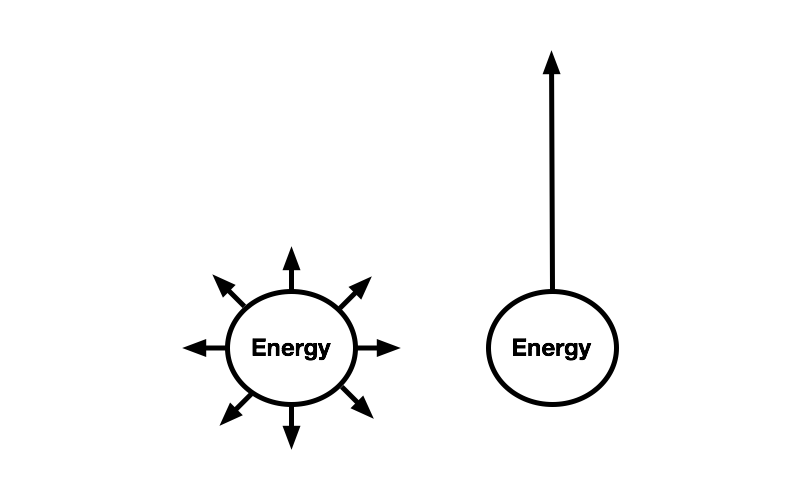
When you’re constantly picking up noise and chasing every bit of information, your energy gets scattered in many directions.
But when your focus is singular—like a straight arrow pointing at one target—all your energy becomes concentrated. You’re able to direct your full power toward one meaningful goal.
People who get results quickly are usually those who decide on their direction early. Start by recognizing how many different “arrows” you’re currently holding and how they might be distracting you. Then think about which direction deserves your full attention.
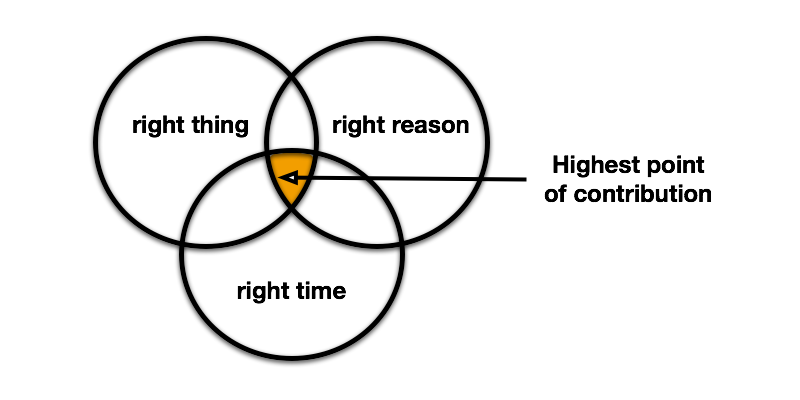
As shown in the diagram above, your highest performance is unlocked when three elements align: the right thing, at the right time, for the right reason.
This is the power of aligning the “What, Why, and When.” When all three intersect, you can achieve extraordinary results with minimal effort.
If you’re stuck in a mindset of constantly looking for reasons not to act…
If you don’t know why you’re doing something, when to do it, or even what you should be doing…
Then it’s no surprise your results will be delayed.
Start by organizing these three elements, and approach life and work with an essentialist mindset. That’s how you create focus, eliminate waste, and unlock your full potential.